


Feeling Unappreciated in a Relationship?
How to Feel Seen and Valued Again
You remember the appointments, ask about the difficult meeting, and make time for the two of you. But when your own day has been hard, nobody asks how you are. The things you do seem to have become expected, and you find yourself wondering whether your partner notices your efforts at all.
Feeling this way does not automatically tell you what your partner thinks or intends. They may care deeply and express it in ways you do not easily recognize. They may also have settled into habits that leave your needs overlooked. Your experience deserves attention in either case. Try to avoid guessing what your partner is thinking, as assumptions can add to the frustration. Asking an open-ended question or explaining how you feel can help start a constructive conversation without making your partner feel accused.
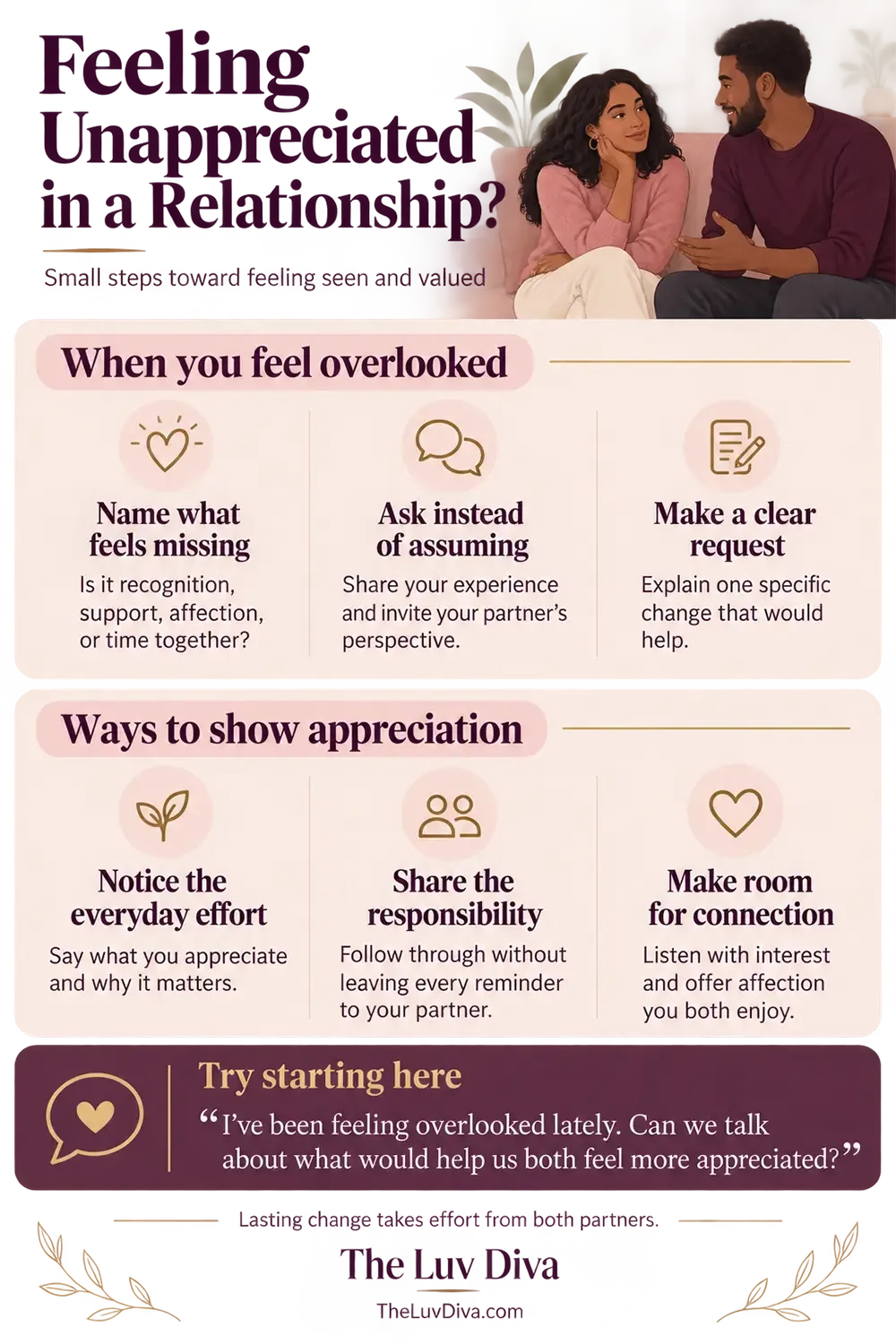
The starting point is understanding what you feel is missing. Do you need to hear more appreciation, have your time respected, or see your partner take a more active role? Naming that need helps you explain your experience without assuming you know why your partner acts the way they do. From there, you can ask for their perspective and talk about what each of you can do to make things better.
What it Means to Feel Unappreciated by Your Partner
Feeling unappreciated usually means there is a gap between what you contribute and the recognition or consideration you receive. You might feel like you’re useful to your partner without feeling especially valued as a person.
Perhaps your partner thanks you for dinner but rarely asks how you are doing. Maybe they say they appreciate you, yet continue leaving you responsible for every plan and decision. For someone else, the missing piece is affection, encouragement, or an occasional gesture that says, “I was thinking about you.”
Feeling this way does not automatically tell you what your partner thinks or intends. They may care deeply and express it in ways you do not easily recognize. They may also have settled into habits that leave your needs overlooked. Your experience deserves attention in either case. It’s also important to not try and be a mind reader, this can complicate an issue that is already bothersome. The best policy is often asking a question or framing how you feel about things without accusing them of not participating or appreciating you.
A forgotten thank-you during a difficult week is different from a lasting pattern of disregard. Consider how often this happens, whether your needs have been discussed, and what your partner does when you bring them up.
Signs That Appreciation May Be Missing
There is no universal checklist that can accurate diagnose all relationships, but these experiences can help you put words to what hurts:
Your efforts receive little acknowledgement unless something goes wrong.
You usually initiate dates, affection, or conversations about the relationship.
Your partner assumes you will handle responsibilities without checking your availability.
Your achievements receive little interest, while your mistakes get considerable attention.
Your need for rest or support is regularly treated as an inconvenience.
You hesitate to share your feelings because previous attempts have been brushed aside.
You feel pressure to keep giving more in the hope that your partner will finally notice.
Try to identify just one or two recent examples rather than building a running tally of every circumstance that bothers you. “I organized our entire weekend and felt like I was overlooked when you didn’t acknowledge it” gives you something specific to talk about. A broad conclusion such as “Nothing I do matters” may capture the hurt, but it leaves the next step less clear.

Why Appreciation Can Fade in a Relationship
Familiar Effort Becomes Easy to Overlook
When someone reliably handles a certain tasks regularly, their personal contributions can become part of the background and not always recognized. The groceries simply appear, birthdays are remembered, and vacation plans always get made. Over time, one partner may stop noticing the work behind those results that the other puts in.
Familiarity can usually explain most oversights, but it does not excuse repeatedly ignoring a concern. Once a pattern becomes clear, both people have an opportunity to work on it and change it.
You Recognize Appreciation Differently
One person might express care by fixing a problem or taking care of an errand. The other may be waiting for recognition, or maybe just a few sincere words. Both can be making an effort while missing what matters most to the other.
Ask each other, “What have I done recently that helped you feel appreciated?” The answer may reveal gestures you overlooked as well as needs that remain unmet.
The Responsibilities Have Become Uneven
Sometimes the issue goes beyond acknowledgement. You may be carrying most of the weight with planning, remembering, and organizing that keeps daily life running. Hearing “thank you” can feel hollow when the same exhausting arrangement continues.
In that situation, appreciation needs to include a practical conversation about ownership. Which responsibilities can your partner take on from beginning to end, without leaving you to supervise?
Stress or Unresolved Frustration is Taking up the Attention
Work demands, money worries, or taking care of the kids can leave less attention available for each other. Lingering disagreements may also make warm gestures feel awkward. Understanding what you’re both going through can help you approach each other with compassion while still asking for the care and support you need.
Love in a Relationship Needs Everyday Attention
Love can feel obvious to the person expressing it, but not always the same to the person receiving it. You might believe that staying committed communicates everything your partner needs to know. Meanwhile, they may be missing the small signs of interest that once helped them feel special.
Knowing your partner’s love language and making your acts of care visible gives your partner something they can appreciate. Ask what helps them feel loved and appreciated. Their answer may have changed as your relationship has evolved.
Stages of Love in a Relationship
It can be useful to think about different seasons of a relationship, without treating them as a fixed sequence that every couple must follow. Early on, appreciation might look like showing curiosity, remembering small details, and making plans to see each other frequently. As you build a shared life, it might involve recognizing sacrifices and sharing the work that comes with new commitments.
Much later, after the relationship is well established, changing careers, parenting responsibilities, or retirement planning can create new needs that consume much of the energy between couples. A simple gesture that once felt especially meaningful may no longer address what your partner is carrying. Ask, “What would help you to feel more supported in our relationship?”
The various stages of love in a relationship should not become an excuse for neglect. Feeling like you’ve settled down with someone still leaves room for affection, encouragement, and positive attention.
Types of Love in a Relationship
Psychologist Robert Sternberg's triangular theory talks about a unique type of framework for understanding love through intimacy, passion, and commitment. In that specific model, romantic love combines intimacy and passion, while companionate love combines intimacy and commitment. Consummate love includes all three. However, these are explained as theoretical categories, not a clinical assessment or a checklist that fits every partnership.
For this conversation, the useful question is which parts of your connection need more attention. You may feel confident in your shared future but miss affectionate interest. Or you may enjoy attraction while wanting greater emotional closeness.
Exploring types of love in a relationship can give you language for those differences. Appreciation becomes practical when you ask how you can express care in a way your partner can recognize, while also being honest about your own needs.
How Feeling Overlooked Can Affect Intimacy
It can be difficult to feel affectionate when you harbor feelings of resentment about how you are treated. You might stop reaching out to your partner, become less playful, or find yourself avoiding conversations because you expect another disappointment.
For many couples that experience this, the distance also reaches the bedroom. A person who feels noticed mainly when sex is wanted may struggle to feel emotionally connected during those moments. Another partner may interpret the reduced affection as rejection without understanding what is behind it.
Appreciation is relevant to relationship satisfaction. In a University of Georgia study involving 468 married individuals, feeling appreciated by a partner was also associated with better overall marital quality. The survey findings also support taking gratitude seriously, however they do not fully establish that expressing thanks alone will repair a damaged relationship.
Rebuilding the closeness with a partner means paying attention to what happens throughout the day, including how you respond to each other's needs. It also means respecting each person's boundaries and comfort with affection. Kindness and household contributions do not typically create an obligation to have sex. Any physical reconnection should be talked about and mutually wanted. In some circumstances, talking with an intimacy coach or clinical sexologist can be helpful.
I am Feeling Unappreciated
If this is a recurring thought you keep returning to, give yourself a moment to think about it before deciding what to do next. You do not need to prove that your partner is a bad person to acknowledge that something hurts. Lashing out without can often lead to greater conflict and distance between partners.
A helpful exercise is to take a few quiet minutes and jot down your answers to the questions below. You don’t need to find the perfect words. Simply be honest and authentic about what you’ve been feeling and what you wish were different.
When do I feel like I’m being overlooked? Think about the moments that tend to leave you feeling hurt or unnoticed by your significant other. Is it when you’ve put effort into something and it goes unacknowledged, when you’re sharing something important, or when you need support and your partner seems distracted?
What do I wish my partner would notice or do differently? Perhaps you’d like them to recognize how much you handle around the house, ask how your day went, or take the time to plan outings together. Try to picture a specific action that would help you feel more valued.
What kind of appreciation am I really missing? Would a sincere thank-you mean a lot right now, or do you need your partner to share more of the responsibilities? Maybe you’re longing for affection or time together without distractions. It’s okay to need more than one of these things.
Have I had a chance to explain what I need? Have you told your partner what’s been frustrating you and what would help, or have you mostly been hoping they’ll notice on their own? It’s understandable to wish they would recognize it on their own. Putting the need into words can help you see whether you understand each other.
When I spoke up about my frustrations, what happened afterward? Did your partner try to understand and try to make changes, or did the conversation end without much follow-through? Think about whether you felt heard and whether any improvements lasted beyond the next day or two.
You may discover that the issue is less about compliments and more about having your time respected. Or perhaps responsibilities feel reasonably balanced, but you miss hearing that your partner enjoys and values you.
This reflection can help you make a solid request to your partner. It does not make you responsible for finding perfect words before they have a responsibility to listen.
How to Say You Feel This Way
Choose a time when you have some privacy and neither person is rushing out the door. You might ask, “Can we make a little time tonight to talk about something that has been weighing on me?”
The University of Minnesota Extension recommends naming some of the specific concerns, while being authentic, and listening to understand before offering any advice in return. These communication habits can make a difficult discussion easier to manage.
Explain what has been happening and how it’s affecting you, then describe a change that you'd like to see that would help. For example:
“I've been scheduling most of our time together lately, and I'm starting to feel like staying connected is mostly my responsibility. I'd love for you to plan something for us this week as well.”
Or:
“When I tell you about something I'm proud of and I’m not recognized for it, I feel overlooked. It would mean a lot if you asked me about it and shared some moments with me.”
If the concern is household chores, be equally direct:
“I appreciate you thanking me for keeping our home organized. I'm also exhausted by being the person who’s in charge of managing our schedules. Can we decide which responsibilities you'll take over completely?”
Give your partner room to respond. They may have missed the impact of their behavior, or they may have some concerns of their own. Those concerns deserve a separate space to be heard, without erasing the issue you raised.
Before ending the conversation, agree on something specific enough to recognize in daily life. “Be more appreciative” leaves a lot to interpretation. Taking turns planning dates or fully owning an agreed responsibility gives you a clearer place to start.

Ways to Show Appreciation in a Relationship
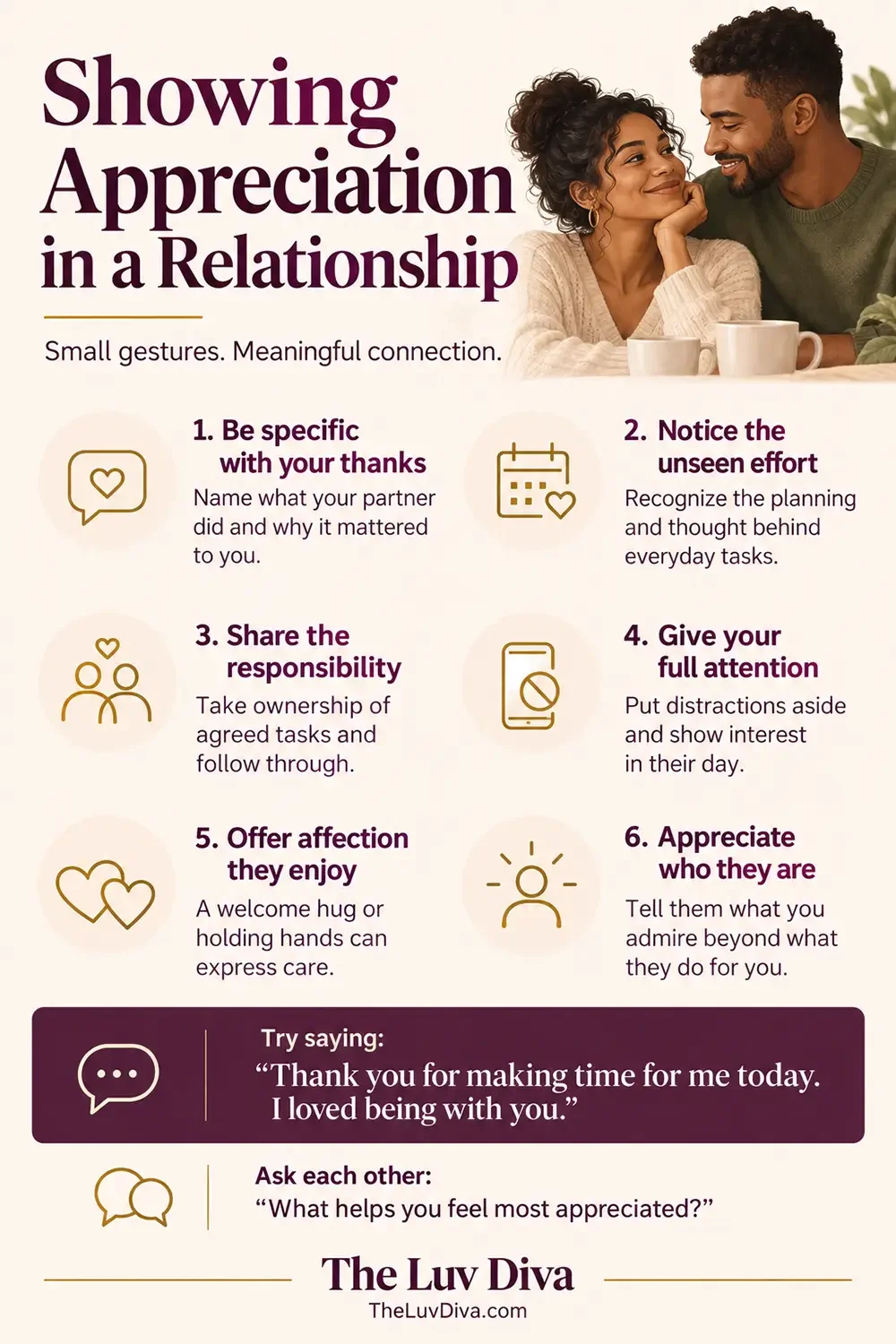
If you are wondering how to show appreciation in a relationship, start with what your partner actually values. The following ideas are a few options to discuss and work on together. You do not need to turn them into a daily to-do list, or complete every one of them. These are ideas to help stimulate more appreciation between you and your partner.
Say What You Noticed
Make your gratitude specific: “I noticed you took care of that appointment while I was working. That made my day much easier.” Naming the effort shows that you paid attention. The Gottman Institute encourages couples to pay attention to their partner's positive contributions and express appreciation for them.
Recognize the Planning Behind the Result
Remembering deadlines, handling the childcare arrangements, and checking that everyone has what they need for the day can take a considerable amount of effort. Acknowledge those tasks, then talk about whether the work load is fairly shared. Recognition feels more credible when you are also willing to carry part of the responsibility.
Take Ownership of an Agreed Responsibility
If you agree to handle dinner twice a week, include the planning and shopping involved. Following through without reminders shows consideration for your partner's time. Ask what would be useful rather than assuming that an unsolicited gesture solves the problem they raised.
Show Interest in Their Inner Life
Ask about something that matters to your partner beyond the household schedule. Follow up on the presentation they were nervous about, the hobby they enjoy, or the idea they mentioned last week. Remembering these details communicates that you are interested in who they are.
Offer Affection They Welcome
A warm hug, holding hands, or sitting close to each other is a good way to show your love for one another when both people enjoy it. If you are unsure what feels good to your partner, simply ask. Let affectionate moments stand on their own without an expectation that they must lead to something else.
Celebrate Qualities in Addition to Accomplishments
Tell your partner what you enjoy or admire about them. You might really enjoy their humor, patience with an older relative, or a willingness to try something new. Being valued for personal qualities can feel especially meaningful when daily life has become dominated by chores and tasks.
Protect Time for Each Other
Make a plan and follow through with it. An evening walk after dinner or a quiet breakfast together can be meaningful when you both want that time. Put distractions aside long enough to enjoy each other's company, and share the responsibility for making these moments happen.
Respect Their Rest and Personal Interests
Appreciation includes treating your partner's downtime as legitimate. Support time for friends, exercise, or simply doing nothing, and make sure both of you have that opportunity. Someone should not have to finish every shared responsibility before their need for rest counts.
Respond Thoughtfully When You Miss the Mark
If your partner says they feel unseen or overlooked, try to fully understand what they’re saying before listing everything you already do. You might say, “I didn't realize that had been falling on you. Let's talk about what needs to change.” Follow the conversation with actions you can help with that are sustainable.
Let Appreciation Remain Free of Conditions
Give thanks without attaching a favor, making a correction, or an expectation for sex. “I appreciate how thoughtful you were today, it means a lot” can be the entire message. Appreciation has more room to feel sincere when your partner does not have to wonder what you want in return.
A Simple Exercise to Try Together
Set aside ten minutes when you both feel you’re able to participate. Each person can finish these sentences:
One thing you did recently that I appreciated was…
Something I have been carrying that you might not see is…
One change that would help me feel more supported is…
After sharing, choose one practical action each of you is willing to take. Keep it manageable and agree on a time to talk about how it went.
This is a conversation starter, not a test to see who contributes the most, it’s not a contest. If someone raises a concern that needs more time to discuss, make time for it rather than trying to squeeze a resolution into the exercise. The aim is to understand each other more clearly and put that understanding into practice.
When You Have Spoken up and Nothing Changes
It’s important to pay attention to the pattern after the conversation. Does your partner show curiosity, take responsibility, and make a genuine effort that continues? Or do you receive a brief apology followed by the same behavior?
Lasting change may take practice, but you should not have to keep explaining that your feelings deserve consideration. If promises repeatedly go nowhere, it may be time to discuss what you are willing to continue doing and what needs to change for you.
A boundary might sound like, “I can handle these two responsibilities, but I cannot keep managing every family commitment. We need to arrange for some down time.” Be clear about your capacity rather than quietly doing more and hoping the frustration disappears.
You can invite your partner to work on things that are important to you, but you cannot supply their willingness. Individual support may help you clarify your needs and choices if they refuse to engage. If speaking up brings threats, intimidation, or fear, prioritize confidential individual support and your safety rather than a joint appreciation exercise.
How Intimacy Coaching can Help you Reconnect
Sometimes couples know they care about each other but struggle to move beyond the same conversation. One person wants to feel valued; the other hears criticism. Both leave frustrated, and the distance remains.
Intimacy coaching can provide a structured space to explore what appreciation and closeness mean to each of you. The work may include clarifying needs, practicing conversations, and choosing realistic habits that support emotional and physical connection. Progress depends on participation and follow-through, and coaching cannot guarantee a particular outcome.
At The Luv Diva, Azure Grayot, a clinical sexologist, offers intimacy coaching for individuals and couples who want to better understand their needs and strengthen their connections. Coaching focuses on education and practical skills; licensed therapy may be more appropriate when concerns require mental health treatment.
If you are feeling unappreciated in a relationship and would like support finding a way forward, explore The Luv Diva's intimacy coaching services. A conversation about what you need can be the first step toward deciding what meaningful change would look like for you.
Feeling Unappreciated - FAQs
Is it ok to want appreciation from my partner?
It’s completely reasonable to want your partner to notice your efforts and consider your needs. The useful question is what appreciation means to you in daily life. Specific examples can help you explain the acknowledgment or help to support you are missing.
Can my partner love me and still make me feel unappreciated?
Yes. Someone can care deeply about you while overlooking the effort you put in, or not expressing it in ways that you need. Love does not remove the need for consideration. Find a way to approach the topic and tell them how you feel. Then take note when your partner responds once they understand your concerns.
What if my partner says I am too sensitive?
That’s might be an unfair assessment if your concerns are dismissed. You can bring the discussion back to the behavior and its impact: “You may experience this differently, but it is affecting how close I feel to you.” Repeated dismissal certainly deserves attention, as this can lead to a larger issue. You do not need to agree on every detail to treat each other's feelings respectfully.
How can I show my appreciation without spending money?
It’s not necessary to shower your partner with thanks to show how you feel about them. A simple thanks, listening with interest, following through on a commitment, or taking care of an agreed responsibility are all signs you appreciate them. Thoughtful gestures can be simple. Ask them what makes them feel most valued rather than assuming an expensive gift is necessary.
Can a relationship improve after years of feeling taken for granted
Improving a relationship is possible when both people acknowledge the pattern of being taken for granted and consistently work on changing it. However, those changes may take time, and new patterns need to be established. Focus on sustained intentional behavior, and consider outside support if you keep returning to the same unresolved discussion